

This page outlines the focus, verification methods, and client relevance of the DIN EN 1793-2 standard, emphasizing our product’s certified airborne sound insulation performance.
Overview
DIN EN 1793-2 is the German national adoption (DIN) of the European standard (EN) within the series for Road Traffic Noise Reducing Devices.
Specifically, Part 2 of this standard specifies the laboratory test method for measuring the intrinsic characteristic of airborne sound insulation (often referred to as sound transmission loss or reflection) of noise reducing devices designed for use alongside roads.
The test procedure involves measuring the difference in sound level between the source side and the receiving side of the noise barrier using the fundamental methodology defined in DIN EN ISO 10140-2. This provides a reliable measure of the barrier’s ability to stop sound energy from passing through its structure.
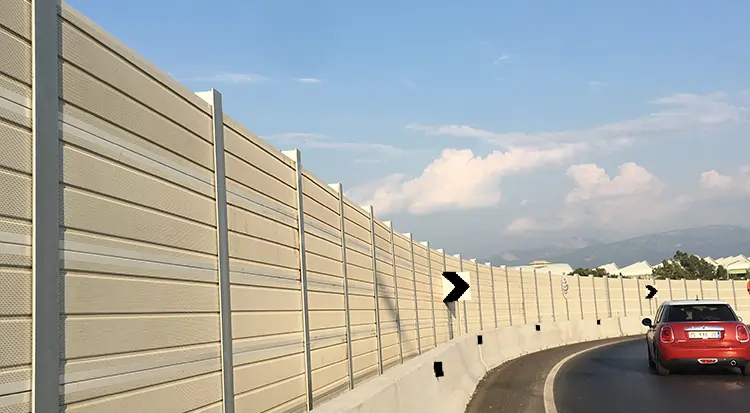
Scope of Accreditation
Our certification under DIN EN 1793-2 confirms that our noise reducing devices, specifically the one-sided absorbent noise barrier of aluminium elements, have been tested and comply with the specific requirements for measuring sound insulation performance, resulting in the following certified performance:
Weighted Sound Insulation Index (DLR): 23dB
Insulation Performance Group: The tested system is assigned to the group of airborne sound insulation B2 (DLR=15to24dB).
The scope ensures:
Sound Transmission Reduction: Verification of the product’s ability to resist the passage of sound through the barrier structure itself.
Testing Methodology: Compliance with the rigorous laboratory test setup defined in DIN EN ISO 10140-2 (Measurement of airborne sound insulation of building elements).
High Intrinsic Performance: The DLR=23dB result places the product in the B2 classification, the second-highest insulation group, confirming its high effectiveness as a noise blocking element.
Testing and Verification
Verification of performance to DIN EN 1793-2 involves specialized acoustic testing to measure the sound reduction achieved by the barrier material when sound attempts to pass through it.
| Test Parameter | Certified Result/Classification | Performance Measure |
| Weighted Sound Insulation Index (DLr) | 23 dB | Single-number rating representing overall sound blocking efficiency. |
| Performance Group | B2 (High Insulation) | Classification confirms high sound insulation performance (15 to 24 dB). |
| Underlying Test Standard | DIN EN ISO 10140-2 | Standard method used for measuring sound transmission loss in a laboratory setting. |
| Test Object | One-sided absorbent aluminium barrier | Confirms the performance rating for the specific construction type. |
The classification of B2 confirms that the material is highly effective at blocking the transmission of acoustic energy, thereby maximizing the noise reduction on the receiver side of the barrier.
What This Means for Our Clients
Choosing our noise barriers, which are tested and certified to DIN EN 1793-2 with a B2 classification (DLR=23dB), provides critical certainty for road infrastructure projects:
Effective Noise Blocking: You are guaranteed a product with a verified high sound insulation rating (DLR=23dB). This B2 classification is vital for effective noise mitigation, as it ensures sound transmission through the barrier is negligible.
Compliance with Strict Specifications: The B2 rating ensures that the product meets the most stringent noise blocking requirements often specified by public and environmental authorities for effective noise reduction strategies.
Reliable Acoustic Design: The quantifiable and independently verified performance data allow acoustic engineers to accurately model and predict the total noise reduction achieved by the barrier, ensuring regulatory compliance.
Dual Performance Barrier: Since this is a one-sided absorbent barrier, the certified B2 insulation (blocking sound) combined with its absorption properties (reducing reflection, per EN 1793-1) provides a comprehensive solution for maximizing noise abatement.
